Planning for a Longer Life: The Five Longevity Risks and the Three Hidden Overlays
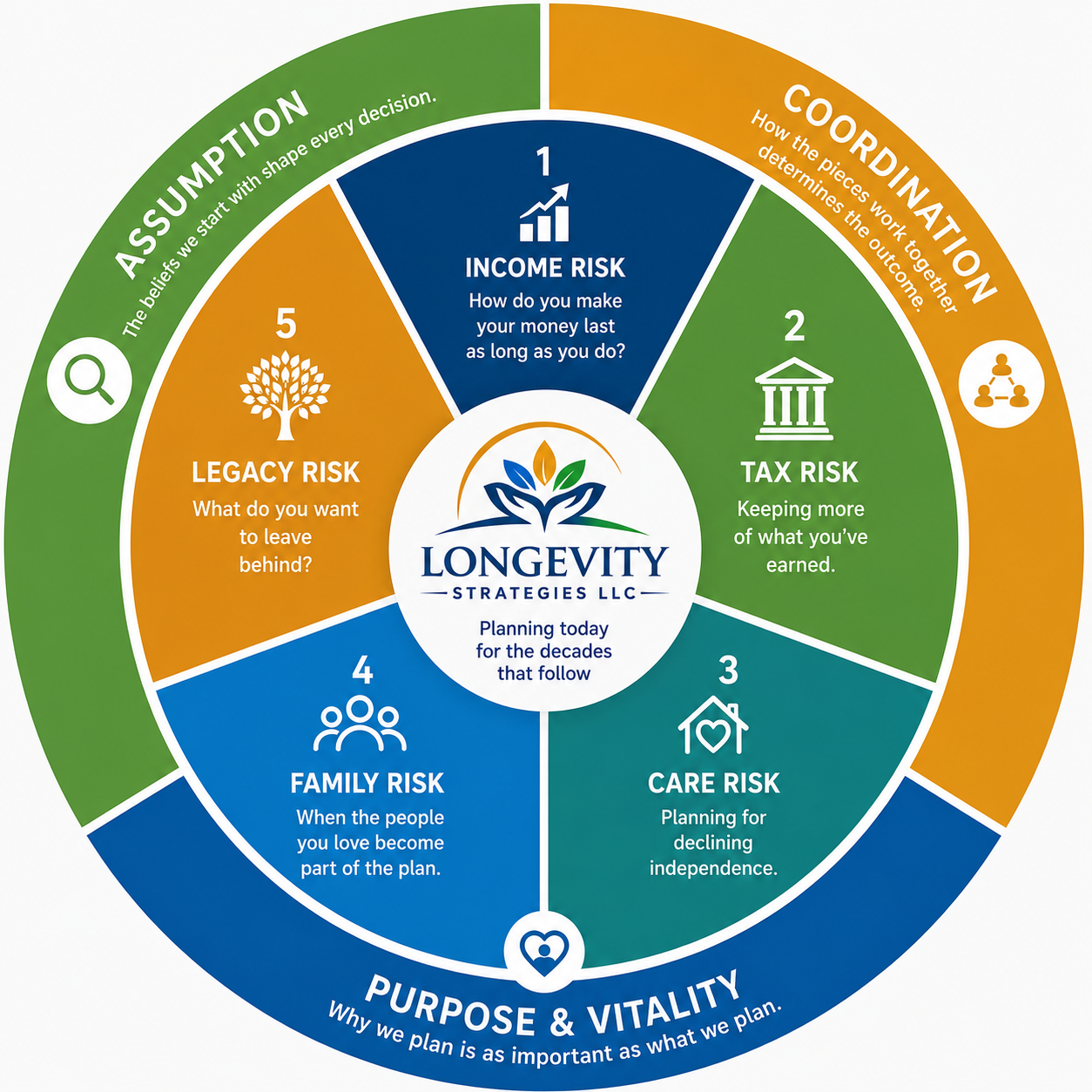
This six-part seminar series introduces the Longevity Strategies framework: five core risks that shape long-life financial security, and three hidden overlays that often determine whether even a technically sound plan will work in real life.
The goal is not merely to ask, “Will the money last?” It is to ask whether income, taxes, care, family roles, legacy wishes, health, purpose, behavior, and decision-making are aligned for the life ahead.
Income Risk
Will Your Money Support the Life You Want?
Most people enter retirement with one central fear: running out of money. But income planning is not only about account balances. It is about knowing which income sources are reliable, how much must come from savings, how withdrawals will be managed, and whether the plan can withstand inflation, market declines, changing health, family needs, and the loss of a spouse or partner.
This seminar explains how to think about income security in a longer life. We will discuss essential spending, lifestyle goals, Social Security, pensions, retirement accounts, annuities, cash reserves, withdrawal risk, and the difference between having assets and having an income plan.
Tax Risk
How Much of Your Retirement Belongs to the IRS?
Taxes can quietly reshape retirement. IRA withdrawals, RMDs, Social Security taxation, Medicare surcharges, capital gains, Roth conversions, charitable giving, survivor status, relocation, and asset sales can all affect how much income remains available to support your life.
This seminar explains why tax planning strategies in retirement is different from tax filing. The focus is not on avoiding taxes altogether, but on anticipating how taxes may change over time and coordinating income, investments, estate planning, and charitable intent in a more tax-aware way.
Care Risk
Who Pays, Who Helps, and Who Decides, If Your Health Changes?
Care planning is one of the most important and most avoided parts of long-life planning. A change in health can affect income, housing, family roles, independence, decision-making, and legacy. It can also place heavy pressure on spouses, partners, children, siblings, friends, or other helpers.
This seminar explores how to think about future care before a crisis. Topics include care preferences, care funding, legal authority, housing, transportation, physical independence, family burden, and the risk of disagreement when several people are expected to help.
Family Risk
Will the People Around You Know What to Do?
Many plans fail not because there was no money, but because roles were unclear. A spouse may not know where documents are. One child may carry the burden while others criticize. Adult children may disagree about care, housing, spending, or inheritance. A partner, friend, or chosen-family member may be trusted but lack legal authority.
This seminar focuses on family and support preparedness. We will discuss decision-makers, backup helpers, sibling conflict, caregiving burden, family communication, dependency, financial boundaries, and the importance of making assumptions explicit before stress exposes them.
Legacy Risk
Will What You Built, Valued, and Intended Survive You?
Legacy is not only about who receives what. It is about whether documents, beneficiaries, asset titles, taxes, family expectations, charitable wishes, and personal values work together.
This seminar looks at legacy as a coordination problem. We will discuss estate documents, beneficiary designations, account ownership, retirement assets, real estate, trusts, charitable intent, blended families, unmarried partners, special circumstances, and the difference between equal treatment and fair treatment.
The Three Overlays
The Hidden Risks: Assumptions, Coordination, Purpose, and Behavior
Some of the most serious planning risks do not appear on a balance sheet. They come from assumptions, poor coordination, avoidance, overconfidence, anxiety, family silence, and unclear purpose.
This seminar brings together the three hidden overlays in the Longevity Strategies framework:
Assumption Risk — What are you assuming others will know, do, or agree to?
Coordination Risk — Do your income plan, tax plan, estate documents, beneficiary forms, insurance, advisors, and family roles work together?
Purpose & Vitality Risk — Does your plan support health, independence, connection, contribution, and a life worth looking forward to?
We will also discuss behavioral and psychological issues that affect planning decisions: procrastination, fear, denial, mistrust, family avoidance, decision fatigue, and the difference between confidence and readiness.